What if don’t rehang what God has torn. In Jesus, God tears the barrier down; our call is to stop sewing it back up? “Tear Down that Veil” follows the tension in the text toward a faithful next step.
Mark 15:38 — “the curtain of the temple was torn in two, from top to bottom.”
Sermon Summary
Opens with Scripture reading and prayer, uses a community fence story to frame God’s welcoming heart, traces Mark’s torn-open motif to the torn temple curtain, diagnoses our fear- and unbelief-driven habit of re-hanging veils, then offers three concrete discipleship practices to cooperate with Christ’s finished work. Provides pastoral cautions about wisdom and boundaries, re-centers on gospel assurance (Psalm 22; Hebrews 10; Ephesians 2), and leads into communion, response, and a closing prayer.
Full Sermon
Main Point
Don’t rehang what God has torn. In Jesus, God tears the barrier down; our call is to stop sewing it back up.
Scripture
Mark 15:33–39 (NIV)
At noon a darkness fell. Near three o’clock, Jesus cried out with the words of Psalm 22: “My God, my God, why have you forsaken me?” Some thought he was crying for Elijah. With a loud cry he breathed his last. At that very moment the curtain of the temple was torn in two, from top to bottom. And a hardened Roman centurion, standing right there, said, “Surely this man was the Son of God!”
Let’s pray.
Lord, open our hearts. Correct us where we are wrong. Help us hear what your Word actually says, not just what we prefer to hear. Make us receptive to Jesus—crucified and risen—tearing down every barrier we’ve put up. Amen.
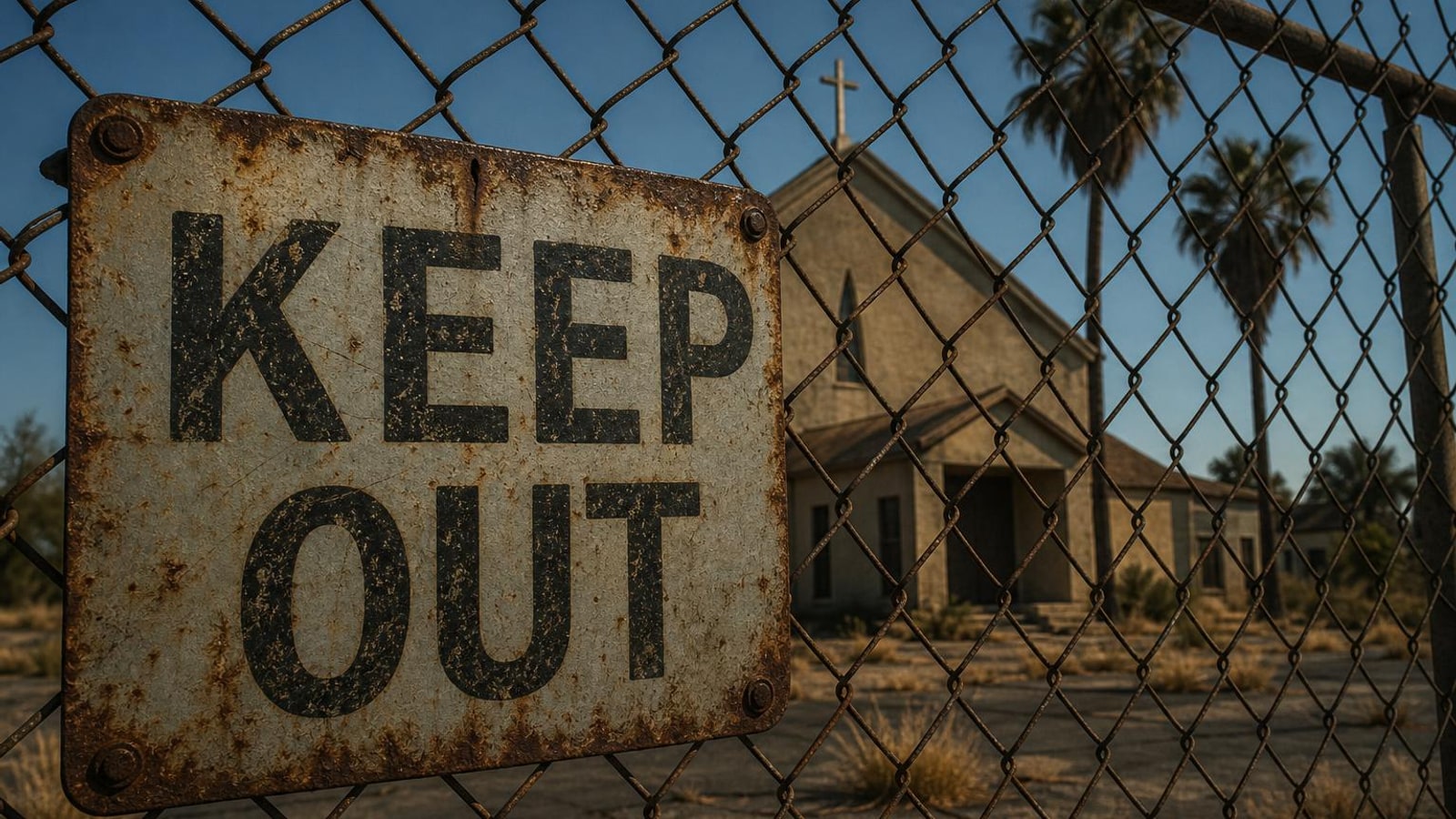
When our church redesigned the garden back in 2022, there was a lot of talk about fences. We used to have a small one with “Keep Out” signs. You know the look: a church that felt like a yard you weren’t sure you should step into. Then came cost overruns, and the fence got cut from the plans. Honestly? We were nervous. What would happen if there wasn’t a fence to keep our neighbors out? Do you know what happened? Nothing bad. In fact, more good things than bad. Neighbors started coming in. Today, we’re one of the only places on Bancroft without a big, unfriendly fence—and it’s catching on. Our neighbors are lowering their fences. People are living with a little less fear because someone decided to stop saying “Keep out” and start saying “Welcome in.”
Friends, that is the heart of God, and it is right there in Mark 15. In Mark’s Gospel, the opening scene of Jesus’ ministry shows heaven being torn open at his baptism (Mark 1:10). At the cross, the temple curtain is torn in two (Mark 15:38). Heaven torn. Curtain torn. From the start to the finish, God is tearing open what sin closed. “From top to bottom—only God can do it.”
We erected the barrier through our sin. And it grows so thick that only God can tear it apart. That’s what the cross is — God doing for us from the top down what we cannot accomplish from the bottom up by our own human effort. But here’s the rub: while Jesus is hard at work tearing veils apart, we keep hanging them back up.
Every time we erect a fence — literal or in the heart — we are hanging a veil of separation and sin. We hang veils between us and God: habits that harden us, resentments we nurse, secrets we protect, shame we hide behind. And we hang veils between us and one another: labels we slap on people, circles we draw to keep “those people” out, “safety” we baptize to cover for fear. We call it prudence, efficiency, or standards. God's word often calls it unbelief and unlove.
What’s wrong beneath what’s wrong? Scripture says the deepest barrier isn’t out there; it’s in here. From the garden onward, when sin entered, the first reflex was fear and hiding. Adam says, “I was afraid… so I hid” (Genesis 3:10). Fear turns us inward and away. And the New Testament adds this: “There is no fear in love. But perfect love drives out fear” (1 John 4:18). When fear leads us, love leaves us. And when unbelief grips our hearts, we turn away from God. Hebrews warns us, “See to it… that none of you has a sinful, unbelieving heart that turns away from the living God” (Hebrews 3:12). Put that together: a fearful, unbelieving heart hangs veils — first toward God, then, becaue our hearts are darkened by fear instead of enlivened with love, we inevitably hang veils toward neighbors.
It’s not just a modern problem. In Mark, people swarming around the cross mishear Jesus, miss who he is, and mock him even as he is opening their access to God. The centurion is the surprise: the outsider sees what insiders miss and says, “Surely this man was the Son of God!” God tears the curtain, and an enemy is the only one who can see the truth. That’s the gospel.
Now, about that curtain. Ancient sources mention more than one: an inner veil before the Holy of Holies, and an outer one at the entrance to the temple. Mark doesn’t specify which one tore. Maybe it was both the inner and outer veil. We are not told. What we are told is the direction — “from top to bottom” — and the timing — right as Jesus dies. That is God’s fingerprint. Whether the emphasis you hear is on the tearing of the inner veil separating us from access to the love of God, or the outward-facing veil representing the outward mission of God's love for the entire world, Jew and gentile alike, Mark wants you to know: God did this. God opened what sin closed.
So if God tears down the barrier, what happens when we keep hanging new ones?
Oh, you and I , we hang a lot of curtains, don't we?
We hang veils toward God — “I’ll come to you, Lord, but not with that sin, not with that scar, not with those people.” We hang veils toward others — “You can come in if you look like me, vote like me, move like me, never inconvenience me.” We invent holy-sounding reasons to keep Jesus out of rooms in our heart and to keep neighbors out of rooms in our life. But the torn curtain announces: God is not interested in our carefully curated distance. He is opening the way. He is making peace. We can participate in his work, or keep fiddling with the curtains trying to undo it.
If fear and unbelief sew new curtains, and if the cross tears them down, how do we live differently? Not by shame. Not by trying to claw our way up to God from the bottom. But by learning practices that cooperate with what God has already done “from top to bottom.” If Jesus’ mission is veil-tearing, then our mission is simple: stop re-hanging what he rips apart.
Let me offer three concrete ways forward.
1) Turn and Tear Within
We must daily turn to Christ and let him remove the inner veil that keeps us from experiencing the fullness of God's love and presence in our lives..
Paul says, “But whenever anyone turns to the Lord, the veil is taken away” (2 Corinthians 3:16). And Hebrews declares, “Therefore, brothers and sisters, since we have confidence to enter the Most Holy Place by the blood of Jesus… by a new and living way… through the curtain, that is, his body… let us draw near to God” (Hebrews 10:19–22). The bible says the body of christ was torn in two to open our access to the love and presence of God.
The heaviest curtain lives in here [beat chest]. Shame. Pride. The story that says, “God is safer at a distance.” The gospel answer is not to perform for God, but to turn to God. Turn, and he takes the veil away. Draw near, because Jesus opened the way. Begin your day unveiled. Before email, before the news, before you build your day’s defenses — turn to the Lord.
Very practically: set a two-minute “veil check” at lunch this week. Ask, “What am I hiding from God right now? What am I afraid to let him touch?” Name it specifically. Confess it honestly. Pray, “Lord Jesus, tear this veil. I turn to you.” If there’s a resentment you’ve rehearsed all morning, picture it as a curtain. And then hand God the scissors.
This is not spiritual heroism. It’s humble permission. When you turn to the Lord, he removes the veil.
2) Cross the Wall
Each week, take one step toward someone you’ve kept at arm’s length.
Paul writes of Jesus, “For he himself is our peace… he has destroyed the dividing wall of hostility” (Ephesians 2:14). The original wall Paul names was between Jew and Gentile—massive, centuries-old. Jesus didn’t just negotiate a truce; he broke the wall down in his own body (Ephesians 2:15–16). And John is bracingly clear: “Whoever claims to love God yet hates a brother or sister is a liar” (1 John 4:20). Our love for the unseen God is revealed in how we treat our seen neighbor.
So choose proximity over suspicion. Every week, cross one small wall: the coworker you are avoiding, the neighbor whose dog annoys you, the family member who drains you, the classmate you’ve labeled, the person you find inconvenient. Inconvenience yourself a little. Last I checked, that's what love looks like. That's what God's love looks like, anyway. There is no genuine love without risk. There is no genuine love without getting hurt. Move toward someone you'd rather run away from in one tangible way, and experience love as God designed it. Not obsessed with managing risk by hiding under a basket, but committed to taking risks that bring his light into the world.
Example: Invite the neighbor you avoid for a backyard chat. Bring coffee to the team member who rubs you wrong and ask one curious question about their life. If someone sits alone, sit there. You don’t have to fix them. Just be proximate. Remember: Jesus is our peace. We are not manufacturing peace; we are walking His peace over.
And yes, love bumps. It can bruise. It can even break things. It interrupts. It is not efficient. But it is the way Jesus walked toward us when we were the ones on the other side of the wall.
3) Redefine Neighbor the Jesus Way
Ask each day, “Who is my neighbor today?” and resolve to serve the most inconvenient answer.
Jesus tells a religious expert the Good Samaritan story to answer a simple question: “Who is my neighbor?” At the end he asks, “Which of these three do you think was a neighbor…?” The man replies, “The one who had mercy on him.” Jesus told him, “Go and do likewise” (Luke 10:36–37). James adds a warning against favoritism — when we favor the comfortable and despise the inconvenient, “have you not discriminated among yourselves…?” (James 2:1–4).
Neighbor-love in Jesus’ mouth is not affinity. Affinity is sticking with your own kind, whatever that means to you. Affinity often turns out to be prejudice disguised as comfort. Neighbor-love, in the Good Samaritan story is the oppposite of affinity. It’s mercy across comfortable lines. It’s not just loving “the person who is like me.” It is especially the person I’d rather avoid.
Try this: make “Who is my neighbor today?” a morning question. Then take the first inconvenient answer and do one mercy. Sit with the student nobody sits with. Offer a ride to the person who relies on the bus. Text the estranged sibling, “Thinking of you. How can I pray?” Choose mercy that costs a little time and comfort.
These three are not techniques or a new law. They are simple ways to stop sewing back up what Jesus has torn down.
Well, all that was a little strong.
A healthy word here: wisdom is not recklessness. Jesus calls us to be “as shrewd as snakes and as innocent as doves” (Matthew 10:16). It's ok to lock your doors at night. Protect the vulnerable. Use good boundaries. Faithful choices reduce some harms but they do not eliminate suffering. If you love and still get hurt, it is not proof you failed. Don’t romanticize danger. Do resist baptizing your comfort as “safety” when it is really just ingrown fear. So much exclusion in our world is not about real danger; it is about discomfort with differences. Let’s stop calling dangerous what is only different. Remember, YOU'RE different too!
Now, what about when we’ve already failed? When the fence is high, the emails are snarky, the heart is hard, and the distance feels set? When the sin is real and the shame is thick? When you know you’ve hung veils between you and God—and between you and someone made in God’s image?
Here is the good news at the center of Mark 15. Jesus does not hand us a needle and thread and say, “Try harder.” He dies with a loud cry, and God tears the curtain from top to bottom. The barrier between a holy God and sinful us — the barrier we could never shred from the bottom up — God rips open from heaven down. This is why Hebrews says we have “confidence to enter the Most Holy Place by the blood of Jesus… by a new and living way opened for us through the curtain, that is, his body” (Hebrews 10:19–20).
Let’s linger in Psalm 22 for a moment — the psalm Jesus prays from the cross. It begins with forsakenness — “My God, my God, why have you forsaken me?it” — but then moves toward a discovery: “He has not hidden his face… when I cried to him, he heard.” The lament gives way to being heard. The torn-ness gives way to welcome. Jesus goes through the full weight of distance ans separation so that you never again have to wonder if God hears you when you cry. He does. The curtain is torn down.
We are not told which curtain, inner or outer. Perhaps God wanted the symbol to cover both: inward and outward action. Either way, the message is unmistakable: access is not achieved by human effort; access is given by God's sacrifice. Not earned; opened. You have not been invited because you are not dangerous. You have been invited because Jesus absorbed all the danger of your sin into himself and made peace by his blood. “But now in Christ Jesus you who once were far away have been brought near by the blood of Christ” (Ephesians 2:13).
And that changes how we treat each other. If God would not keep you out — if anyone had a good reason to tell someone “Keep out,” it would be God who would be justified in saying it to us — what possible right do we have to rebuild “Keep Out” signs over people Christ bled to welcome? When we hang a veil between us and a neighbor, we make the cross a plaything.
So come to the Table through the torn curtain — through Christ himself. This meal is our weekly walk through the portal God opened “from top to bottom.”
In the cup, we receive saving grace. The cup points to the blood of Jesus, poured out for the forgiveness of sins. If your shame says, “Stay away,” the cup says, “Come near.” The blood has opened the way.
In the bread, we receive sustaining grace. The bread points to Christ’s presence with us, nourishing us for the road ahead. If your fear says, “You can’t keep this up,” the bread says, “You don’t walk alone. I am with you always.”
We are not saved because we love so well. We come to the Table because Christ has done what we could not do. Then, strengthened by his grace, we return to faithful discipleship — turning and tearing the veil within, crossing walls, redefining neighbor.
In a moment, as we come, bring your veils. Bring them all. Name them. The secret sin you think God won’t touch. The person you keep away. The “Keep Out” sign you hung over an entire group of people. Lay those filthy rags down. Jesus has already torn the barrier that mattered most. Walk through the open veil of his torn flesh into the Holy of Holies — into his presence and peace.
So, church: don’t rehang what God has torn. In Jesus, God tears the barrier down; our call is to stop sewing it back up.
Let’s come to the Table.
[communion]
Closing Prayer
Father, thank you for tearing the curtain from top to bottom. Thank you for Jesus, who opened a new and living way through his own body, who turned our forsakenness into welcome. Forgive us for the veils we have hung—toward you and toward our neighbors.
Father, We lift eyes beyond this moment. When our future is unveiled. Scripture promises a day when “God’s dwelling place is now among the people” (Revelation 21:3), when “there is no temple” in the city, “because the Lord God Almighty and the Lamb are its temple” (Revelation 21:22). Every tribe welcomed. Every tear wiped away. No more death, no more division, no more curtains. The Lamb who was slain will be our light.
By your Spirit, teach us to turn to you each day with unveiled faces. Make us a people who cross walls and redefine neighbor by mercy. Keep us wise, not reckless; bold, not bitter; hospitable, not hostile. Nourished by saving grace in the cup and sustaining grace in the bread, send us to live what we have received. And hasten the day when every curtain is gone, every tear is wiped, and the Lamb is our light. Until that day, we live now as a sign of that future — no “Keep Out” signs on our hearts, no stitched-up separations in Christ’s church.
In the name of the Father, and of th eSon, and of the Holy Spirit, Amen.
This Week’s Bulletin
Follow along with the message outline and Pretty Good Questions.
Reflection and Discussion Questions
- What veil am I hiding behind with God right now, and how will I turn to Jesus to let him tear it this week?
- Who is one person I’ve kept at arm’s length, and what simple step will I take to cross that wall?
- Where have I posted a “Keep Out” sign in my life, and what does mercy require of me today?