
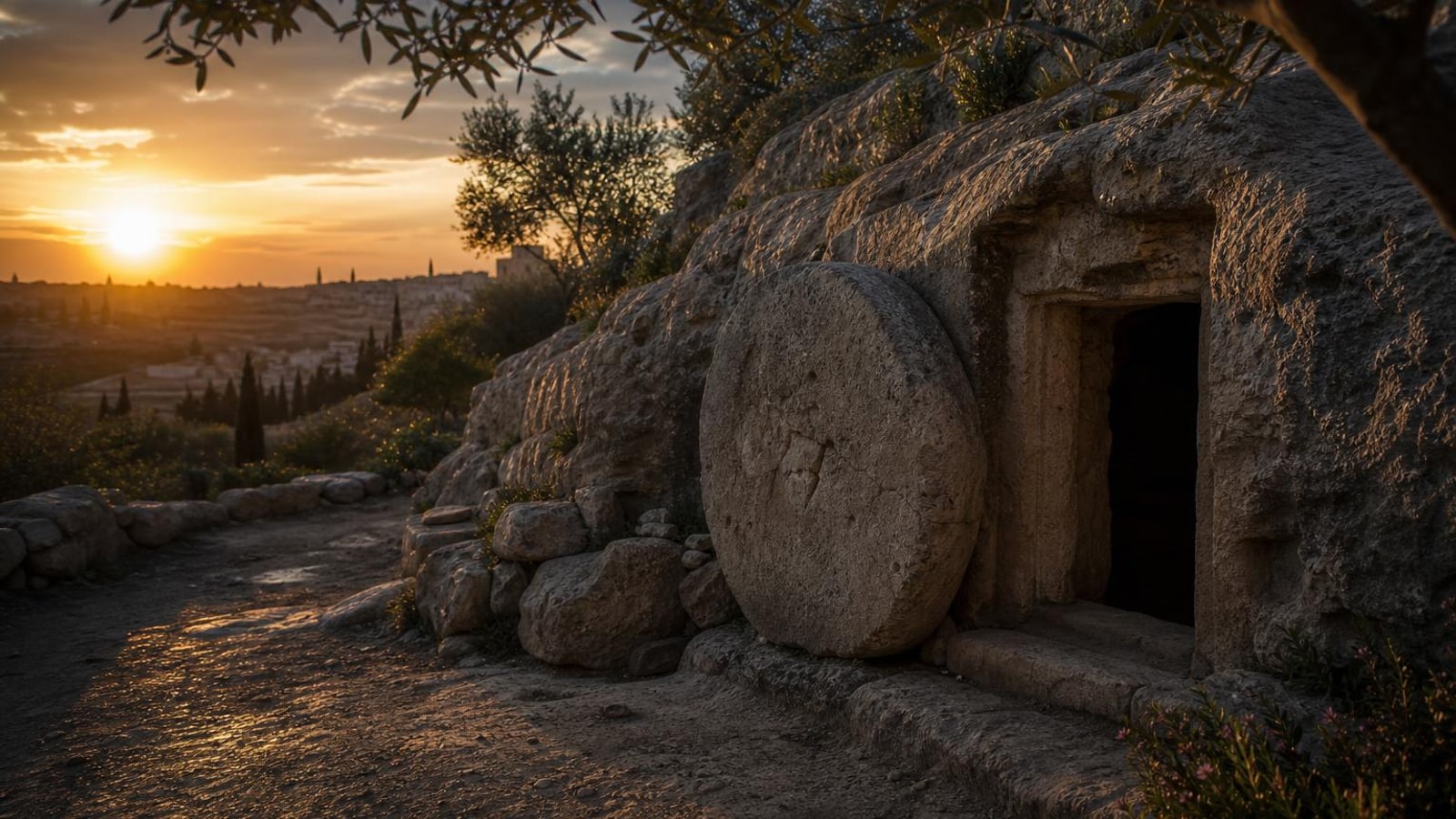
What is God inviting us to see—and do—through “Love Steps Up at the Tomb”? Follow the message from the tension in the text toward a faithful next step.
Mark 15:46 — “wrapped it in the linen … laid him in a tomb.”
Sermon Summary
The message opens with prayer and an introduction framing Mark 15:40–47 as a verified account of Jesus’ death and burial, highlights the women’s presence and Joseph’s bold action, diagnoses why we hold back, and teaches three practices of love (stay near, step up, see and say). It offers a pastoral caution, proclaims gospel assurance in Christ’s death, burial, and resurrection, then moves to communion, response, eschatological hope, and a closing prayer.
Full Sermon
Title: Love Steps Up at the Tomb
Main Point
When others stood back, love stepped up: Joseph’s courage and the women’s witness set the stage for Easter hope.
Scripture
Mark 15:40–47 (NIV) — summary
After Jesus breathes his last, Mark slows the camera. Some women who had followed Jesus “from a distance” are still there—Mary Magdalene, Mary the mother of James the younger and of Joseph, and Salome. They had cared for his needs in Galilee; now they remain, watching. As evening approaches, Joseph of Arimathea—a respected council member “waiting for the kingdom of God”—“went boldly to Pilate” and asked for Jesus’ body. Pilate verifies the death with the centurion and releases the body. Joseph buys linen, takes Jesus down, “wrapped it in the linen,” and lays him in a rock-hewn tomb, sealing it with a stone. “Mary Magdalene and Mary the mother of Joseph saw where he was laid.”
Opening Prayer
Lord, open our hearts to your Word. Correct us where we’ve edited you to fit our preferences. Help us hear what Scripture says, not just what we want it to say. Make us receptive to Jesus—crucified, buried, and risen—and make us a people who step up in love. Amen.
Introduction
The Paper You Never Wanted to Need
Have you ever had to prove that someone you love has died? It sounds harsh to say out loud. But after a funeral, ordinary life throws bureaucracy at your grief. Banks ask for documentation. Utilities want proof. Insurance needs forms. To navigate the detritus after loss, you need a document that certifies the unthinkable: a death certificate.
Mark 15:40–47 reads like the gospel’s death certificate. It is sober. Verified. Pilate asks the centurion, “Is he really dead?” Joseph handles the body. Linen. Tomb. Stone. Women who “saw where he was laid.” This is not rumor. Not wishful thinking. Not “maybe he fainted.” Jesus truly died and was truly buried.
But this quiet scene is not only paperwork. It is love stepping up when the crowds have gone home. It is ordinary courage and faithful presence in the face of darkness—actions God uses to set the stage for Easter.
If Mark slows down here, perhaps we should too.
What We See—and What We Avoid
Mark highlights two groups.
First, the women. “Some women were watching from a distance.” They had followed him, cared for his needs, supported the ministry. When things turned ugly, many ran. These women remained. From a distance, yes—but still present. Still watching. Still loving. “Mary Magdalene and Mary the mother of Joseph saw where he was laid.” That slow, careful seeing will matter on Sunday morning. They will know exactly which tomb is empty.
Second, Joseph of Arimathea. Mark calls him a prominent council member “waiting for the kingdom of God.” We are told he “went boldly to Pilate.” That verb is strong—he dared. He took the risk. He used his position not to protect himself but to honor Jesus. He didn’t give a speech. He didn’t organize a rally. He bought linen, asked permission, took down the body, wrapped him, and laid him in the tomb. Holy love with calloused hands.
Friends, this is where the gospel lives most days—not on stages, but in rooms that smell like tears and antiseptic. Not in grand gestures, but in faithful presence, quiet courage, and practical mercy.
And here is where we feel the pinch. So often we keep suffering at arm’s length. We “watch from a distance” because it’s safer there—less messy, less costly, less awkward. We hope someone else will make the call, handle the logistics, sit in the hospice chair through the night.
Why We Step Back
Why do we hold back? Scripture shines a light on our insides.
- Fear. “Fear of man will prove to be a snare” (Proverbs 29:25). We worry, “What will this cost me? My reputation? My time? My comfort?”
- Approval. John says there were leaders who believed in Jesus, “but because of the Pharisees they would not openly acknowledge their faith … for they loved human praise more than praise from God” (John 12:42–43). Respectability can keep us quiet when love calls us forward.
- Unbelief in small mercies. We assume if we can’t do something big, it doesn’t matter. But Joseph’s courage wears work clothes: linen, labor, lifting.
We are not told exactly what moved Joseph from quiet waiting to bold action. Perhaps (speculation) the sight of the crucified King finally broke the dam of caution. Early Christian preachers noticed that turn. One preached, “This was Joseph, who was concealing his discipleship of late; now however he had become very bold after the death of Christ.” He had been cautious; then love stepped up.
And God used it. The women’s faithful seeing and Joseph’s faithful doing become the hinge of the gospel story: they close the day of death and quietly set the stage for the dawn of resurrection.
So how do we live differently? If fear and the hunger for approval keep us back, what practices train our hearts to draw near? Scripture gives us a way.
Three Ways Love Steps Up
1) Stay Near
Scripture
Mark 15:40–41; Hebrews 13:13
Some women “were watching from a distance.” But notice: they stayed. Mark reminds us these were the same women who had “followed him and cared for his needs” in Galilee. Their ministry didn’t end when ministry got dangerous. It deepened. Faithful presence is not always loud. Often it is simply not leaving.
Hebrews invites us, “Let us, then, go to him outside the camp, bearing the disgrace he bore.” Jesus died “outside the camp,” outside respectability. Love goes there. Love stays there.
What does this look like?
- Sit in a hospice room. No magic words. Just presence.
- Send the text—and then show up. Bring a meal, then linger long enough to do the dishes.
- Stand graveside with a hand on a shoulder. Weep with those who weep.
For the shy, the background saints—this is your sweet spot. You don’t need the stage to be like Jesus. You need a chair next to a hospital bed. You may not say much. But prayer can hum under your breath the whole time. Prayer is the heartbeat of this kind of love.
2) Step Up
Scripture
Mark 15:43
“Joseph of Arimathea … went boldly to Pilate.” He dared. He took initiative. He didn’t wait to be asked. He didn’t form a committee. He did the next faithful thing in front of him. He went, he asked, he bought linen, he took down, he wrapped, he placed, he rolled a stone.
Courage often looks like concrete mercy.
What might that be for you this week?
- Offer to coordinate a meal train for a family in crisis.
- Volunteer to handle funeral or medical paperwork others are too overwhelmed to face.
- Advocate discreetly for someone being overlooked—a neighbor, a co-worker, a student—using whatever “access” your position gives you to do good.
Maybe you say, “But I’m not brave.” Notice: Joseph’s action isn’t bravado. It’s love making a choice. Courage grows as we make the next right choice and then the next—and we pray as we go. Bring your trembling to God. “Lord, I’m scared. Show me the one bold step I can take today.” And then take it.
3) See and Say
Scripture
Mark 15:47; 1 Corinthians 15:4
“Mary Magdalene and Mary the mother of Joseph saw where he was laid.” That simple, careful seeing is not filler. It positions them to bear honest witness later. On Sunday morning when the stone is rolled away, they can say with integrity, “We know this tomb. We saw this place. He was buried here. Now he is gone.”
Paul later summarizes the gospel facts: “that he was buried, that he was raised on the third day according to the Scriptures.” The burial matters because the resurrection is not vague encouragement—it is God’s act in history. Careful seeing today becomes credible witness tomorrow.
Practice
- Keep a brief journal during a hard season. Note the mercies—small and large: a text at the right time, the nurse who stayed late, strength you didn’t think you had.
- When hope breaks in—when a prayer is answered, when a prodigal calls, when peace settles unexpectedly—share it humbly with a friend, a small group, a neighbor. Not to show off, but to strengthen faith.
Seeing and saying is not spin. It is quiet honesty about God’s presence in dark places.
A Healthy Word of Caution
We need to say this out loud: following Jesus is not a technique for avoiding pain. Sometimes you will stay near, step up, see and say—and still weep. Prayer is not control over God. Wisdom reduces some harms but cannot erase a fallen world. Suffering is not proof you failed the three steps. These practices train us to love like Jesus amid sorrow. They do not purchase painless outcomes.
Good News for Those Who Already Stepped Back
But what about when we didn’t? What about the moment we stayed far away? The time we put reputation over love? The week we were just too tired to show up? What about the damage already done?
Here is the good news: Jesus not only died for us—he was truly buried for us. The creed-like summary puts burial right in the center: “that Christ died for our sins according to the Scriptures, that he was buried, that he was raised on the third day” (1 Corinthians 15:3–4). Burial says the curse ran its full course; death was not dodged. He went all the way down into our grave, carrying our sin and shame.
And on the third day, the same Jesus who was “thoroughly dead and buried” was raised. The empty tomb is not a metaphor for springtime. It is the beginning of new creation. One thoughtful Christian writer has said that the best explanation for the rise of the church is this: the crucified Jesus, really dead and buried, really rose. That is our hope. Not our perfect courage. Not our flawless presence. Christ is our hope.
So bring your failures to him. Bring the memory of the hospital room you didn’t enter, the phone call you didn’t return, the fear that kept you back. His cross covers our cowardice. His resurrection breathes new courage into shy hearts. The Spirit of the risen Christ meets background saints and makes them bold in all the right ways.
Communion
Saved and Sustained
This is why we come to the Table today.
- The cup is saving grace. It points to Christ’s blood poured out for the forgiveness of sins—fear, distance, and all. We are not saved because we perform our three practices well. We are saved because Jesus has done what we could not do. He died for our sins. He was buried. He was raised. Receive saving grace.
- The bread is sustaining grace. It points to the living Christ who feeds and strengthens those who will stay near and step up. You do not have to generate courage from your own resources. The risen Jesus nourishes you for the road ahead. Receive sustaining grace.
If you are a shy saint, a background person, hear this: the Lord delights to meet you here. You don’t need the spotlight to be faithful. You need his life in you.
Response
As we come to the Table, some of us may want to come to the front for prayer as well. Perhaps you need courage for a particular step. Perhaps you carry regret for a moment you stepped back. Perhaps you are in the vigil beside a loved one right now and you are tired. Bring it to Jesus. Ask a brother or sister to pray with you. And if you prefer to pray quietly where you are, that is welcome, too. Background saints often carry the church in hidden prayer. Today, let the church carry you.
Eschatological Hope: Why We Keep Showing Up
We practice courageous love now because we know where this story is headed.
- “He will swallow up death forever. The Sovereign Lord will wipe away the tears from all faces” (Isaiah 25:8).
- “He will wipe every tear from their eyes. There will be no more death or mourning or crying or pain” (Revelation 21:4).
- “Therefore, my dear brothers and sisters, stand firm. Let nothing move you. Always give yourselves fully to the work of the Lord, because you know that your labor in the Lord is not in vain” (1 Corinthians 15:58).
One day there will be no more hospital vigils, no more paperwork after funerals, no more stones to roll, no more tombs to visit. Until that day, we keep staying near, stepping up, and seeing and saying—because Love stepped up for us, and Life stepped out of the tomb.
Come quickly, Lord Jesus.
Closing Prayer
Father, thank you for the quiet courage of Joseph, for the faithful presence of the women, and above all for Jesus—crucified, buried, and risen for us. Forgive us for staying at a distance when love called us near. Free us from the snare of fear and the hunger for human praise. By your Spirit, teach us to stay near, to step up, and to see and say your mercies. As we receive the cup of saving grace and the bread of sustaining grace, strengthen us for the work of love in a world still full of funerals. Keep our eyes on the day when death is swallowed up and every tear is wiped away. Through Jesus Christ our Lord. Amen.
Reflection Questions
- Where have you recently found yourself “watching from a distance” instead of drawing near to someone’s pain?
- What fear or desire for approval (Proverbs 29:25; John 12:42–43) most often keeps you from stepping up in love?
- Which of the three practices—Stay Near, Step Up, See and Say—do you sense the Spirit nudging you to begin this week? What concrete action will you take?
- Where have you seen God’s quiet mercies in a hard season? Who needs to hear that honest testimony?
- What regret do you need to bring to Jesus today? How does his death, burial, and resurrection meet you there?
This Week’s Bulletin
Follow along with the message outline and Pretty Good Questions.
Reflection and Discussion Questions
- Where is Jesus calling you to stay near this week, and what simple act of presence can you offer?
- What one bold, concrete step of mercy will you take, and who will you ask to pray for courage?
- What have you seen God do in a hard season, and how will you share that witness to strengthen another?